
Market players said a big upmove by the market will depend on policy action by the government to revive economic growth and corporate earnings revival.

The combined interest payment for India's top listed companies, excluding financial and oil and gas firms, was up 15.2 per cent year-on-year during the six months ended March 2019, outpacing the change in net sales and operating profit.

Monsoons have had limited effect on market returns for a given year, report Sachin Mampatta and Sundar Sethuraman.

More asset sales may be only way out, though most of the group companies' ratings have been downgraded and their combined market value is now a fraction of their combined debt.
Starting April 1, a non-executive director of 75 years or more can be appointed or re-appointed only by way of a special resolution, which requires 75 per cent 'for' votes.
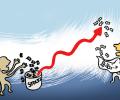
So far in 2019, India has been one of the highest recipients of foreign flows among Asian and Emerging Market (EM) economies

While discount brokers have managed to grow at a rapid pace, they have not been successful in capturing substantial market share in the above-40 age category.

While divestment through IPOs saw an over 90 per cent drop as compared to the previous financial year, the exchange traded fund (ETF) route proved to be a shot in the arm for the government, reports Sundar Sethuraman.

The risk-reward ratio could turn adverse for foreign investors if corporate earnings disappoint by wide margins, or if crude oil prices spike in the international market, putting pressure on the rupee-dollar exchange rate.

The Hinduja Group, Mukesh Ambani, Murugappa, and the Adani groups were the other gainers in the Modi regime, while Naveen Jindal and Sun Pharma groups saw the most erosion in their m-cap in the last five years, reports Krishna Kant.

Experts say foreign investor sentiment was bolstered by the US Federal Reserve's decision to go slow with interest rate hikes and hopes of political stability.

Global funds have pumped in over Rs 38,000 crore (about $5.5 billion) into domestic equities since February 20, helping the Sensex rebound 2,671 points, or 7.6 per cent, from its 2019 low.

The mid- and small-cap indices had a dream run between January 2017 and January 2018 - zooming 48 per cent and 56 per cent, respectively.

Analysts attribute this fall to the recent moderation in energy (mainly crude oil) and commodity prices, lowering of input costs for companies in sectors such as FMCG, consumer durables, and automobiles, reports Krishna Kant.

While the fresh issue portion of IPOs has been going down over the years, this financial year has been abysmally low at only Rs 2,663 crore, 82 per cent lower compared to the last financial year.

The weakness in the rupee and broader markets has led to evaporation in the market cap.

Five to six issues may hit the market if Chalet Hotels's IPO is successful and if there are no negative surprises in the Union Budget on February 1.

Financial planners advise against putting capital to work by anticipating what might go up or down.

Listed realty developers saddled with unsold properties worth Rs 1 trillion

'IPOs not clicking is cause for worry,' says Sebi chairman.
 © 2026 Rediff.com - Advertise with us - Disclaimer - Privacy Policy - Sitemap - Feedback - About us - Terms of use - Grievances